Tampilkan postingan dengan label labour. Tampilkan semua postingan

04/12/11

Terminating withholding without being terminated

Not to be argumentative, but maybe instead of "exempt" a man or woman might write "except"ed 26 USC 3401(a)(8)(A)(I):

HEADSec.3401. Definitions -STATUTE- (a) Wages For purposes of this chapter, the term ''wages'' means all remuneration (other than fees paid to a public official) for services performed by an employee for his employer, including the cash value of all remuneration (including benefits) paid in any medium other than cash; except that such term shall not include remuneration paid - (8)(A) for services for an employer (other than the United States or any agency thereof) - (i) performed by a citizen of the United States if, at the time of the payment of such remuneration, it is reasonable to believe that such remuneration will be excluded from gross income under section 911;

Congress does clearly say "except" and not "exempt". Wonder why?

Maybe it has something to do with the Congress' defined employer and employee?

(c) Employee
For purposes of this chapter, the term ''employee'' includes an officer, employee, or elected official of the United States, a State, or any political subdivision thereof, or the District of Columbia, or any agency or instrumentality of any one or more of the foregoing. The term ''employee'' also includes an officer of a corporation.

(d) Employer
For purposes of this chapter, the term ''employer'' means the person for whom an individual performs or performed any service, of whatever nature, as the employee of such person, except that - (1) if the person for whom the individual performs or performed the services does not have control of the payment of the wages for such services, the term ''employer'' (except for purposes of subsection (a)) means the person having control of the payment of such wages, and (2) in the case of a person paying wages on behalf of a nonresident alien individual, foreign partnership, or foreign corporation, not engaged in trade or business within the United
States, the term ''employer'' (except for purposes of subsection (a)) means such person.

16/11/11

Public Letter to Prime Minister of India about Investigating Ambani International Loot

Honorable Prime Minister of India, 

Dr. Manmohan Singh, 
Copy to Director CBI, 
Mr. A.P. Singh, 
New Delhi. 

Respected Sir, 

I have proposed in another communication that PMO ought to Knowledge Center within to proactively deal with Political & Executive mischief in dealing with corruption and Corporate Corruption, Hoarding, Environment Issues and Rogue Officers. 

Hamish McDonald has written extensively on Ambani loot in books published in 1998 and 2010, mirror to world. Why can't CBI work on the latest cases of loot? I have provided summary of Ambani Loot with this message. 

It takes only one Step – All the World's knowledge is accessible to Me to PMO & CBI – I am connected PMO & CBI not. Once PMO has the knowledge Center- infrastructure already provided - Every Department shall have it – NGO shall follow PMO than Advani or Sidhu. 

Since 1975 I have 90% success rate – either in Preventing Loot or Predicting Accurately a decade in advance – Narmada Canal Network is Over Designed and huge waste of public money and loot in 1999 – 10 yrs ahead of CAG report that reported just 6.56% new command use. 

We have to Prevent Corruption & Loot – not create 'Prosecution Infrastructure To Deal With Corrupt After Loot' intended by Jan Lokpal. 

KC in PMO for example would have written to DoT a day after June11, 2010 RIL Press Release 'When 4G license acquired by RIL for Rs.4500 crores is more capable than entire Telecom Infrastructure why DOT is promoting investing in out dated technologies?' Could have been - 'Why are Telecoms not utilizing Optic Fiber to full capacity created in 2002 deploying Indigenous Technologies in 2004? At that time Korea Singapore Japan were promoting Optic Fiber technologies. 

I was telling Sub-Inspector I was youngest Junior Engineer selected through UPSC Test made in charge of Biggest Electrical Store in 1976 serving 50% of India but had 100% control over the not just the Store but also controlled DGSD and ISI – anyone whispering in my ears 'Last Consignment of Lamps Burnout in 15 Days' in one second I would add two more words 'Please Issue Good Quality Lamps' – no new order was placed for local companies supplying substandard products after that. 

In doing so I had Virtually Acquired the authority of DG, DGSD, ISI, CE Vigilance, etc. etc. 

In 1975 I applied for Indian Oil contest and next day NRDC for assistance to file patents and commercialization – both released my ideas to others, and I was required to monitor Patent Gazette on regular basis thus acquired knowledge and capability similar to level of Einstein but related to Technologies Projects. 

But was horrified to find matters of KG basin reported to PMO for 3-4 years had made no progress even though full details were provided. About 18 months ago it was Inspector rank officer dealing with it now in new Building it was Sub-Inspector who I believe had invited some official of RIL and was also recording my conversation. 

Why can't CBI assign a number to a Complaint and put it on its website – or let some Associated NGOs do it? 

I told them all my Petitions are circulated to over 25,000 professionals world over. I can operate Official CBI blog to put up all valid and important complaints. 

Promoting RIL presently has become International Tragedy. Coal fired projects being promoted are Most Polluting in the world. 

India is yet to develop 150,000MW of own hydro power and over 80,000 MW over international rivers. Indigenous Mining of Coal that cost $10 per tone is stagnant – corporate to have acquired Indian mines were allowed to invest in foreign mines that shall cost $200 per tone so by 2014 India shall import 180 million tones of coal that may exceed 500 million tones. 

In 24 Hours PMO can be Super Computerized and best in the world. CBI world's best Investigating Agency. 

From the very beginning Dhirubhai Ambani and his sons corrupted and manipulated Indian government is explained in 'The Polyester Prince: The Rise of Dhirubhai Ambani' by Hamish McDonald and its sequels 'Mahabharata in Polyester: The Making of the World's Richest Brothers and Their Feud' and 'Ambani & Sons' from 1999 onwards brothers turned in to Multi Head Monster – last year Makesh & Anil Ambani were worth $45b and $42b Consolidating Equity Holdings to over 50% and equity of Indian small shareholders who filled the stadiums reduced to under 10% in RIL companies and Staff costs are not even 2%, but unlike pre 1999 when units performed at near full capacity, Companies are performing poorly or are Hoarding on Licenses, Resources and Real Estate. 

CAG, TRAI, DGH & Electricity, Mining Regulators were corrupted. Mukesh Ambanis 4G acquisition is not yet under CAG CBI scanner. 

$150b invested or Committed by India In Last 12 Yrs on Ambani Companies yield little benefit.

When PSUs were Vertically Split & Only Allowed Horizontal Expansion – Ambanis Were Allowed Unlimited Unrestricted Vertical & Horizontal Expansions.

RIL Refineries are mainly export oriented contributing little to India, Telecom Companies is under utilized, high cost services are operated, Oil & Gas in spite of 10 times higher capitalization than Petrobras barely contributes 5% of Oil & Gas needs in 12 years. Reliance Wellness or Reliance Retail stores sell most goods at MSP like other shops are mainly Real Estate Investments. Out of 35,000 MW power projects just 600MW has been commissioned by Reliance Power in ten years, out of 95 million tones of Coal Mining projected production there is no production yet from mining leases. 34,000 hectares of SEZ had failed to take off – mainly hoarding program to develop real estate. RIL was caught Re-routing of International Telephone calls as locals, Rigged Electricity Meters programmed to run fast in Delhi. Awarded EPC contracts to China for Power Plants, Gas Pipelines than Indian companies but are still much behind schedule. Consumers are least satisfied with Reliance Electricity Distribution & Telecom Companies. 

Blitz observed: If the allegations against Dhirubhai Ambani and Reliance are proved, whether in the matter of evasion or in the alleged fraud of letters of credit opened with two foreign and three Indian banks for the import of PTA, then the conclusion becomes inescapable that, since 1969, a single industrialist had been literally dictating the government's tex­tile and import policies and maneuvering import rules to 'kill' his rivals and maintain his lead in the market ... The challenge to State Power lies in the accumulated wealth and economic clout in the hands of an individual who is neither an elected representative nor accountable to the people, who could rnanipulate Cabinet ministers as wed as party chiefs. Economic power goes hand in hand with its political counterpart, resulting in manipulating politicians and ministers right to the top of the top. AN this and more has put a new regime seeking to cleanse the Augean stables of the corporate sector in an extremely vulnerable position for its daring to challenge one of the biggest industrial empires with a Rs 27 crore show-cause notice. One can only wish Finance Minister V P Singh good luck with the danda [stick] now that the carrot has been spurned - from Polyester Prince.

1999 onwards Reliance rapidly expanded in to Refineries, Oil & Gas, Power, Telecom, SEZs, Retail, Infrastructure, Insurance, Capital, Healthcare, Entertainment in addition to Textiles, Petrochemicals, etc. 

Reliance consolidated promoters equity, acquired licenses, Hoarded on to land, mining leases, Oil & Gas blocks and invested in foreign countries. 

Oil & Gas - $500b Production Loss 

1. RIL Operates 29 Blocks in India and 13 Overseas –Brazil licensed a 13,000 sq.mt block to 13 private companies for off shore exploration RIL acquired 25 blocks by 2001 when it had no off shore experience by engaging hiring NIKO, HEPI and HARDY for the purpose of Acquiring & Hoarding Oil & Gas blocks. 

Though it made World's biggest discovery of 2001 that RIL claimed was 40 times larger than Bombay High of ONGC but still it made no efforts to developed it and instead invested in Two Refineries that were executed speedily than VITAL Offshore 25 Blocks in 2001 to 29 blocks now. 

2. GSPC too made Biggest Discovery in 2005 like in RIL case in very first well – but didn't invest in developing the Oil & Gas at Deendyal Block acquired in NEPL III in 2001 – Gujarat backed down to let RIL monopolize the Oil & Gas operations. This discovery within 20-30 kilometers adjacent to KG D6 could have been directly connected to onshore separation & dehydration process of CNG for pumping it to destinations. 

Both RIL & GSPC without drilling rigs commenced exploration two to four years after acquiring blocks in 1999 and 2001 NEPL bids. 

RIL awarded Turn Key contract to develop KG D6 to Bechtel only in 2006, five years after discovery and seven years after NEPL-I that was commissioned in April2009. Instead of 200 MSCMD of natural gas and plus some million tones of Crude Oil India get just 41 MSCMD of gas as per latest quarterly report and little crude oil. India could have been self sufficient in Oil & Gas by 2005 and saved $500b worth petroleum imports. 

3. When GAIL out to have laid Common Coastal Gas Pipeline from 1999 onwards, for all the licenses RIL corrupted DGH in to not considering CCGP and let RIL have its own Gas Pipeline that was built by Chinese from 2007, (six years after discovery and 8 years after NEPL I) to be ready by 2009 – this too discouraged other Oil & Gas operators from investing in Oil & Gas blocks. 

4. When Brazil operated around 20 Offshore Drilling rigs in a Block leased to 13 companies RIL operated just one Drilling Rig for a while recently and hired just three rigs for 29 blocks December2011 onwards – and these too are Most Expensive over $0.510m per day rent when ONGC hired 7-9 rigs of various sizes at $0.140m average cost. (Copy Attached) 

5. RIL had claimed to have discovered 40 times more gas at KG D6 than ONGC and it shall double Natural Gas production, would supply gas for a Century and shall be operational in 30 months from October31, 2002 but commenced production after 77 months from 2002 or 113 months after NEPL-I. Since RIL was allocated KG D6 in 1999 and till October31, 2002 it had developed just Three Wells but your government allocated 25 Blocs to RIL in NEPL I. II and III. Four Telecom Companies – High Cost Services, Low Utilization, Poor Service 1.23m Land Lines, 135m Wireless, 2.1m Internet Subscribers

5. Ambanis operated two Telecom Companies in 2001-02 itself as per AR Page 44 i.e. Reliance Telecom and Reliance Infocomm, licensed to operate 2G CDMA, GSM, Land Lines, WLL, Internet, Broadband, Optic Fibre, IPTV, VOIP, DTH, Cable TV etc. but it preferred Most Expensive Mobile Phone based services that relied on 97% foreign hardaware. (Secretary Telecom pointed out our hardware content in mobile phones is just 3% while releasing report on Mobile Handsets.) Ambanis, through backdoor acquired SWAN Telecom 2008 and Infotel Broad Band 2010 for 3G and 4G services. 

As per detailed TRAI Performance indicator – Reliance operated just 1.23 million land lines out of 34.73m. just 3%, operated 135m wireless subscribers out of 811m, over all served 16.18% of Telephone subscribers. 

6. Reliance Infocomm owned over 2,70,000 kilometers of Optic Fibre terabit network alone capable serving over 200 million Broad Band connections i.e. every household in India but Reliance served just 2173463 internet connections or just 1% of potential out of 19674983, 11% share – just 2m out of 20m. BSNL operated 11316919 Internet connections or 57% in India. 

Most of the Optic Fibre network was laid in Metros in 2002 itself or Metros could have World Class broad bank services for 10 years. During the year, RIL acquired a 95% stake in Infotel Broadband Services Limited, which emerged as a successful bidder in all the 22 circles of the auction for Broadband Wireless Access (BWA) spectrum conducted by the Department of Telecommunication, Government of India. RIL has invested Rs. 4,201.64 crore by way of subscription to equity capital issued by Infotel Broadband.' RIL AR 2010-11 Page 19. http://adf.ly/3l2Lk

RIL sees the broadband opportunity as a new frontier of knowledge economy in which it can take a leadership position and provide India with an opportunity to be in the forefront among the countries providing world-class 4G network and services. A single 20 MHz TDD spectrum when used with LTE (Long Term Evolution) has the potential of providing greater capacity when compared to existing communication infrastructure in the country.

7. CAG Manipulated 2G Loss Figures – is illustrated by two important statements – 4G services across 22 circles for Rs.4500 crores as license fee has greater capacity than prevailing Communications Infrastructure. 

8. CAG maliciously with political motive implicated PM, Home Minister and Finance Minister in recent letters & communications also. Reliance Added Just 600MW of 35,000MW in 10Yrs

9. RIL tookover BSES (Reliance Power) in 2001 in latest AR2010-11 in a para admits it commissioned just 600MW out of 35,000MW and mining leases with 95 million tones capacity are not producing any coal. "The Company is in the business of setting up and operating power projects and in the development of coal mines associated with such projects. The Company has identified a large portfolio of power projects of more than 35,000 MW and is also developing coal mines with a potential to produce over 95 million tonnes of coal per annum (MTPA). Of the power projects which the Company is developing 600 MW are already operational while the balance capacities are under various stages of development". BSES Rs.3000 Cr Loot in 2000-01

10. BSES in 2000-01 purchased electricity worth Rs.1005 crores and I found out of MERC case at Rs.1.77 per unit (NTPC generation cost then was 0.93p per unit) or 568 crore units, BSES own generation at Dahanu was 362 crore units "so availability was 930 crore units but BSES declared sales of 541 crore units. On sale of 541 crore units input energy required to cover 12% T&D losses, 3% HT losses, auxiliary losses of 6% was around 630 crore units "so clearly BSES UNDER DECLARED 300 crore units sales of electricity that delivered to Industries would be worth Rs.1,800 crores. 

This is over and above Profits Declared by BSES that year was Rs.321 crores, so gross LOOT was Rs.2121 crores. Considering NTPC would have supplied 541 crore units at under Rs.800 crores, add Staff cost of Rs.122 crores, Dividend of Rs.60 crores and Rs.112 crores for O&M adds up to Rs.1100 crores but Energy Sales was Rs.2158 crores. All this adds up to Rs.3000 crores annual loot. 

[Source of this Loot was 50% increase in power tariff in Maharashtra State in 1996 primarily for MSEB serving large state with over 30% T&D losses and Agricultural load but BSES applied this tariff to its licensed area when T&D losses in BSES area of Mumbai were 12% and there was no farming load and from 1995 commissioned 500MW own power generation.] Energy Imports to Exceed $400b by 2020 Doubling GHG

11. Private Companies have taken over Coal Mining leases in India & Foreign countries but not working on India with potential to produce 300 million tons annual potential leading to critical shortages. Mining cost in India is $10 to $20 per tone, imported Coal though superior cost 10 times more – by 2014 India is to import 180 million tones of coal. 

Energy Imports Coal, Oil & Gas by 2020 may exceed $400b annually. India required just about $400b to install 200,000MW of Hydro Power projects, having 500 BCM storages on Indian Rivers providing flood protection and irrigation supplies doubling food production and also 60,000MW Nuclear Power. 34,000 Hectare SEZ Loot Program

12. RIL spear headed SEZ loot prog acquiring prime land in Mumbai and Delhi suburbs – 34,000 Hectares or 85,000 acres at Rs.50 crore per acre developed real estate is Rs. 42,50,000 crore business value – this is Rs.20,00,000 crore loot. 

Reliance Power also grabbed 2500 acres of land for Gas Power Project for 3500MW to 10,000 MW that required just about 350 acres of land. Call Re-Routing & Rigged Electricity Meters

13. Ambani Group Company used Nokia Technology explained in US Patent 7120441 to cheat PSU Telecoms re-routing ISD calls as locals and abused GE technology described in USP 6459258 by installing Programmable Most Expensive Meters purchased on consumers account. GE patent describes technology of installing two programs in computerized meters – one operating and other for reference – whenever Meters developed problems operating program was replaced by reference program but Reliance companies installed two or more programs one accurate and others fast.

28/01/11

4 preliminary recommendations to Human rights

From 10 to 21 January 2011, I carried out a fact-finding mission to assess the situation of human rights defenders in India, and traveled to New Delhi, Bhubaneshwar (Orissa), Kolkata (West Bengal), Guwahati (Assam), Ahmedabad (Gujarat), Jammu and Srinagar (Jammu and Kashmir).


I met with the Foreign Secretary; the Union Home Secretary; the Additional Secretary (International Organisations and Environment Diplomacy); the Joint Secretary (Human Rights), Ministry for Home Affairs; the State Chief Secretary, State Home Secretary and Director-General of Police in states visited; the Chairperson of the National Human Rights Commission; Members of the Statutory Full Commission; Chairpersons and Members of State Human Rights Commissions; and Judges from the High Court in Delhi. However, I regret I was unable to meet the Prime Minister, nor with members of the Parliament.


I met as well with members of the diplomatic community and United Nations agencies in the capital. Finally, throughout my mission, I met a very wide and diverse segment of the civil society through national and regional consultations.


I thank very much the Government of India for extending an invitation to me and for its exemplary cooperation throughout the mission. I further want to thank all human rights defenders with whom I had meetings, some of whom had to travel long distances to meet me. Finally, I want to express my appreciation to the Office of the United Nations Resident Coordinator in India for its invaluable support in preparation of and during the mission. 


While I must now take some time to review and analyse the considerable amount of information I have received, and to follow up on further exchanges of information with the Government, human rights defenders and other stakeholders, I would like to provide a few preliminary observations and recommendations.


I first want to commend the Government for opening its doors to my mandate. Previous requests to visit India were made by my predecessor in 2002, 2003 and 2004. This is an important development, and I hope that the invitations of other Special Procedures mandate-holders will be similarly honoured in the near future.


I further commend the Government for enabling me to visit five States, which assisted me in gaining a clear understanding of the local specificities in which human rights defenders work. Given the duration of the mission and the size of the country, I regret I could not access all parts of the country, but I invite those who wish to do so to provide me with information now or in the near future.


I note with satisfaction that India has a comprehensive and progressive legal framework which guarantees human rights and fundamental freedoms, as enshrined, inter alia, in the Constitution, the Protection of Human Rights Act, the Scheduled Castes and Scheduled Tribes (Prevention of Atrocities) Act, and the Right to Information Act. I welcome the commitment expressed by Indian authorities to uphold human rights.


I further welcome the draft Bill on the Prevention of Torture with a view to ratifying the Convention Against Torture in the near future. Besides the National Human Rights Commission and existing State-level Human Rights Commissions, I note the existence of a wide range of Statutory Commissions mandated to promote and protect the rights of, inter alia, women, children, scheduled castes and scheduled tribes.


However, despite the aforementioned laws aimed at promoting and protecting human rights, I note widespread deficiencies in their full implementation at both central and state levels, adversely affecting the work and safety of human rights defenders. Similarly, I have observed the need for the National and existing State Human Rights Commissions to do much more to ensure a safe and conducive environment for human rights defenders throughout the country.


Throughout my mission, I heard numerous testimonies about male and female human rights defenders, and their families, who have been killed, tortured, ill-treated, disappeared, threatened, arbitrarily arrested and detained, falsely charged, under surveillance, forcibly displaced, or their offices raided and files stolen, because of their legitimate work in upholding human rights and fundamental freedoms.


These violations are commonly attributed to law enforcement authorities; however, they have reportedly also shown collusion and/or complaisance with abuses committed by private actors against defenders. Armed groups have also harassed human rights defenders in some instances.


In the context of Indias economic policies, defenders engaged in denouncing development projects that threaten or destroy the land, natural resources and livelihood of their community or of other communities, have been targeted by State agents and private actors, and are particularly vulnerable.


I am particularly concerned at the plight of human rights defenders working for the rights of marginalized people, i.e. Dalits, Adavasis (tribals) religious minorities and sexual minorities, who face particular risks and
ostracism because of their activities. Collectivities striving for their rights have in fact been victimized.


Women human rights defenders, who are often at the forefront of the promotion and protection of human rights, are also at particular risk of persecution.


Right To Information (RTI) activists, who may be ordinary citizens, have increasingly been targeted for, among others, exposing human rights violations and poor governance, including corruption of officials. Other defenders targeted include those defending womens and child rights, fighting impunity for past human rights violations, seeking accountabilityfor communal pogroms, upholding the rights of political prisoners, journalists, lawyers, labour activists, humanitarian workers, and church workers. Defenders operating in rural areas are often more vulnerable.


While I acknowledge the security challenges faced by the country, I am deeply concerned about the arbitrary application of security laws at the national and state levels (in Jammu and Kashmir and in the North-East of India), most notably the Public Security Act and the Armed Forces Special Powers Act, the Jammu and Kashmir Public Safety Act and the Unlawful Activities Prevention Act, which direly affects the work of human rights defenders.


I am troubled by the branding and stigmatization of human rights defenders, who are labeled as �naxalites (Maoists)�, �terrorists�, �militants�, �insurgents�, �anti-nationalists�, �members of underground�. Defenders on the ground, including journalists, who report on violations by State and non-State actors in areas affected by insurgency are targeted by both sides.


Freedom of movement of defenders has also been restricted under these security laws; for instance, applications of passport or renewal have been denied, as well as access for defenders to victims in some areas. Illegitimate restrictions to freedom of peaceful assembly were also brought to my attention: for example, I was informed of instances of protests in support of a human rights defender in detention which were not allowed to take place.


Finally, I am concerned about the amendment to the Foreign Contribution Regulations Act which provides that non-governmental organisations must reapply every five years for the review of their status by the Ministry of Home Affairs in order to receive foreign funding. Such a provision may be used to censor non-governmental organisations which are critical of Government�s policies.


In view of the above, the space for civil society is contracted. Although the judiciary is the primary avenue for legal redress, I have observed that its functioning is hampered by backlog and significant delays in administrating cases of human rights violations.


The National Human Rights Commission and the existing State Human Rights Commissions is an important additional avenue where human rights defenders can seek redress. However, all the defenders I met during the mission voiced their disappointment and mistrust in the current functioning of these institutions. They have submitted complaints related to human rights violations to the Commissions, but reportedly their cases were either hardly taken up, or the investigation, often after a significant period of delay, concluded that no violations occurred. Their main concern lies in the fact that the investigations into their cases are conducted by the police, which in many cases are the perpetrators of the alleged violations. While I welcome the establishment of a human rights defenders focal point within the National Human Rights Commission, I regret that it was not given sufficient prominence within the Commission.


Based on the above, I wish to make the following preliminary recommendations:


*To the Central and State Governments:*


- The Prime Minister and the Chief Secretaries should publicly acknowledge the importance and legitimacy of the work of human rights defenders, i.e. anyone who �individually and in association with others, [�] promote[s] and [�] strive[s] for the protection and realization of human rights and fundamental freedoms at the national and international levels � (article 1 of the Declaration on Human Rights Defenders, A/RES/53/144).

Specific attention must be given to human rights defenders who face particular risks (as identified above).


- Security forces should be clearly instructed to respect the work and the rights and fundamental freedoms of human rights defenders, especially human rights defenders who face particular risks (as identified above).


- Sensitization training to Security forces on the role and activities of human rights defenders should be delivered, with technical advice and assistance from relevant UN entities, non-governmental organizations and other partners.


- Prompt and impartial investigations on violations committed against human rights defenders should be conducted, and perpetrators should be prosecuted.


- The Supreme Court judgment on police reform should be fully implemented in line with international standards, in particular at the State level.


- Full implementation of laws and policies which guarantee human rights and fundamental freedoms of human rights defenders should be ensured.


- A law on the protection of human rights defenders developed in full and meaningful consultation with civil society and on the basis of technical advice from relevant UN entities should be enacted.


- The Foreign Contribution Regulation Act should be critically reviewed.


- The Draft Bill on Prevention Against Torture should be adopted without further delay.


- The Optional Protocol to the Convention on the Elimination of all forms of Discrimination Against Women should be ratified. The ratification of the complaints procedure will provide women human rights defenders an
opportunity to access another procedure to address any violations of rights under the Convention.


- The Armed Forces Special Powers Act and the Public Security Act should be repealed and application of other security laws which adversely affect the work and safety of human rights defenders should be reviewed.


- The functioning of the National Human Rights Commission should be reviewed with a view to strengthening the Commission by, inter alia: broadening the selection criteria for the appointment of the Chairperson; diversifying the composition of the Commission; extending the one-year limitation clause; establishing an independent committee in charge of investigating complaints filed; elevating the status of the human rights defenders focal point by appointing a Commissioner. The Protection of Human Rights Act should be amended as necessary in full and meaningful consultation with civil society.


- State Human Rights Commissions should be established in States where such commissions are not yet in existence without further delay.


- Central and State Governments should continue collaborating with Special Procedures of the Human Rights Council, including by extending invitations for country visits.


*To National and existing State Human Rights Commission:*


- The supportive role of the commissions for human rights defenders should be strengthened by inter alia, conducting regular regional visits; meeting human rights defenders in difficulty or at risk; and undertaking trial observations of cases of human rights defenders wherever appropriate. 

- The visibility of the commissions should be ensured through regular and proactive engagement with civil society and the media. 


- A toll-free 24-hour emergency hotline for human rights defenders should be established.


- The commissions should monitor the full implementation of recommendations made by UN human rights mechanisms, including Special Procedures mandate-holders, Treaty Bodies, and the Universal Periodic Review.


*To the judiciary:*

- In the absence of a witnesses and victims protection Act, the judiciary should take measures to ensure the protection of human rights defenders at risk, witnesses and victims.


- The judiciary should ensure better utilization of *suo motu*whenever cases of violation against human rights defenders arise.


- The importance of the role of human rights defenders in the vibrant and active functioning of the judiciary should be recognised. 


*To human rights defenders*

- Platforms or networks aimed at protecting defenders and facilitating dialogue should be devised or strengthened.


- Defenders should better acquaint themselves with the Declaration on Human Rights Defenders. 


- Efforts should be made to continue making full use of United Nations Special Procedures and other international human rights mechanisms when reporting on human rights violations.


*To the international community and donors*

- The European Union Guidelines on Human Rights Defenders and local strategies on India should be implemented on a systematic basis.


- The situation of human rights defenders, in particular the most targeted and vulnerable ones, should be continually monitored, and support for their work should be expressed through, inter alia, interventions before
central and state institutions.

- Efforts should be intensified in empowering civil society.

*To all stakeholders:*

- The Declaration on Human Rights Defenders should be translated in main local languages, and disseminated widely.


- Efforts should be continued to raise civic awareness among the general public, and the spirit of dialogue and cooperation in society fostered.


I will present my full report with final conclusions and recommendations to the UN Human Rights Council in March 2012.


07/10/10

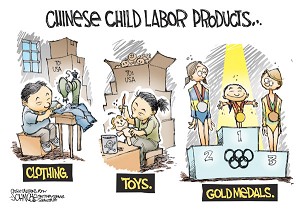
Chinese toys tainted by lead or made by child labour

China makes 80 per cent of the world�s toys, but it has come under attack for its poor safety record (toxic materials and unsafe working conditions). Even standards body has been criticised for corruption. Exports drop.


Beijing (AsiaNews/Agencies) � Rampant corruption is undermining safety standards in mainland China's toy factories, which meet 80 per cent of global demand but that could be slapped with an embargo. According to the South China Morning Post, Chinese toy manufacturers blame quality control auditors employed to enforce standards for receiving bribes in order to turn a blind eye to the increasingly stringent safety standards demanded by foreign retailers.


Corruption between manufacturers and auditors is so bad that the International Council of Toy Industries' Care Foundation (ICTI)�a worldwide industry programme to promote ethical manufacturing�has sacked about 20 of the 145 mainland auditors so far this year, or 14 per cent of the total. "Bribery and wages are not the only problems," said Ian Anderson, vice-president of the foundation's Asian operations, who spoke yesterday at a seminar. "We have found child labour cases every month."

The problem is not new. In 2007, the United States banned the sale of toys made in China for toy multinational Mattel because of excess lead in paint used in products for toddlers. At least, two million toys were recalled.

On 31 October 2007, Guangdong authorities stripped or suspended the manufacturing licence of 764 plants because of safety concerns. They also set a deadline for 690 plants to improve manufacturing and product quality.

In the last few years, accusations of child labour have also surfaced. In some plants, children are often hired, ostensibly enrolled in early school vocational training in which they are underpaid and forced to work in unsafe conditions.

About 2,300 factories employing 1.7 million workers worldwide have enrolled in the ICTI programme, a set of best practices that are recognised in the US and in several European countries. However, the increasingly tough standards are causing problems of their own.

Lawrence Chan Wing-luen, chairman of toymaker Wynnewood Corp, who has been in the industry for 37 years, said some manufacturers have been tempted to save money by ensuring positive reports by bribing auditors rather than improving conditions in their factories.

He is critical of the excessive power such officials exerts, and would like to see greater control exerted on them. Chinese manufacturers are afraid that new scandals might negatively impact exports, already reeling from the worldwide crisis. Last year, the mainland exported US$7.78 billion worth of toys, 10 per cent less than in 2008. About 3,000 manufacturers export toys, down from a peak of about 8,500 in 2007 as the industry grappled with toy recalls and safety issues.